





News | 27 February 2026
Brazil: a key market for global sustainability
Saul Ferrer Vera, Head of Strategy & Innovation, BBVA Brasil
Brazil is emerging as one of the most compelling sustainability markets globally. Beyond its natural endowment, the country combines economic competitiveness, supportive public policies and industrial scale, accelerating the transition and creating sizable investment opportunities across multiple sectors.
A differentiated starting point: clean, competitive energy
Brazil starts from a unique position. Around 90%+* of its electricity generation mix is already clean (solar, wind, hydroelectric, biomass, geothermal, and nuclear energy), compared to approximately 43% globally. Over the past decade, the expansion of solar and wind energy has been particularly strong, with growth rates far exceeding global averages (solar +120% and wind +20% between 2015 and 2024).
Clean sources are already the cheapest option for new power generation in Brazil, reinforcing a structural competitive advantage. This underpins two powerful trends:
- Electricity demand is expected to grow by +15% by 2030, with continued growth toward 2050.
- Electrification across transport, industry and buildings is set to accelerate.
*Source: Bloomberg NEF
Brazil’s relevance in the global sustainability landscape
Brazil’s sustainability opportunity must be understood in a global context. Few countries combine, at the same time, scale, natural resources, clean energy leadership and industrial relevance in a way that allows the transition to generate impact at scale.
Brazil stands out internationally for:
- Its clean energy leadership, with around 90% of power generation coming from clean sources, placing it among the frontrunners globally.
- Its diversified resource base, enabling large-scale deployment of renewables, bioenergy and emerging clean technologies.
- Its industrial relevance, acting as South America’s main industrial hub and a key node in global value chains, particularly in automotive, energy and infrastructure-related sectors.
The country’s energy supply mix is also among the least dependent on fossil fuels among large economies, reinforcing its attractiveness as a platform for low-carbon industrial activity. Moreover, Brazil’s scale and territorial diversity mean that sustainability solutions developed locally — across regions, sectors and use cases — can be replicated at scale, turning the country into a natural laboratory for the energy transition.
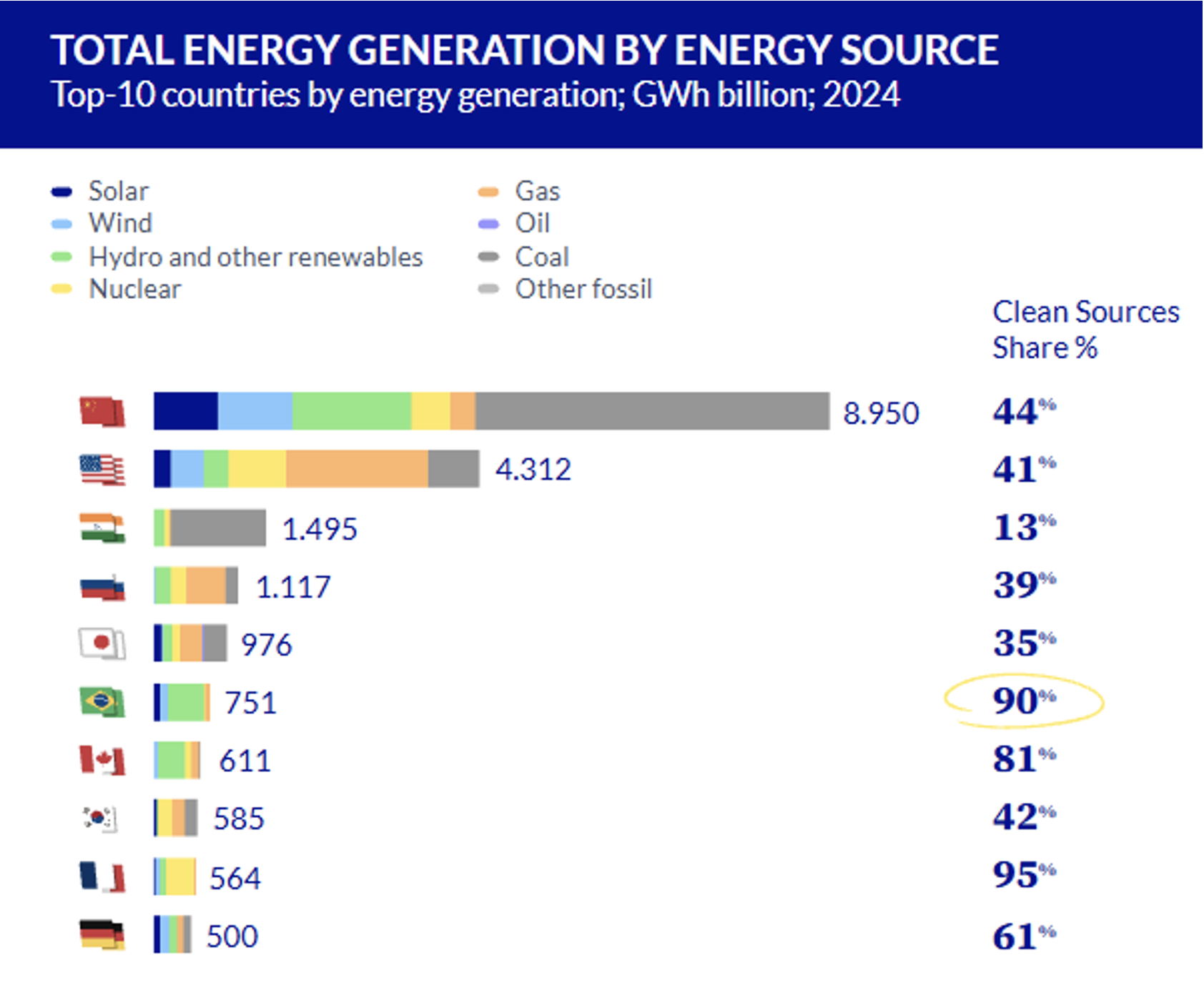
Other renewables mainly include biomass and geothermal.
Moreover, Brazil’s scale and territorial diversity mean that sustainability solutions developed locally — across regions, sectors and use cases — can be replicated at scale, turning the country into a natural laboratory for the energy transition.
Policies, industry and finance as transition enablers
Brazil’s sustainability momentum is not only technology-driven. Public policy plays a central role:
- 2035 climate target: 59–67% GHG emissions reduction vs. 2005 levels.
- Public initiatives and plans to mobilize capital toward decarbonization, such as the Eco Invest program, TFFF(Tropical Forest Forever Facility), and the issuance of $2bn in sovereign sustainable bonds.
- Net Zero by 2050 commitment.
- Blended finance recognized as a key lever to de-risk projects and mobilize private capital.
- Ambitious water and sanitation targets, aiming for 99% population access by 2033.
- Pro-industrialization policies and fiscal incentives are accelerating investment in electric mobility, low-carbon technologies and new industrial value chains.
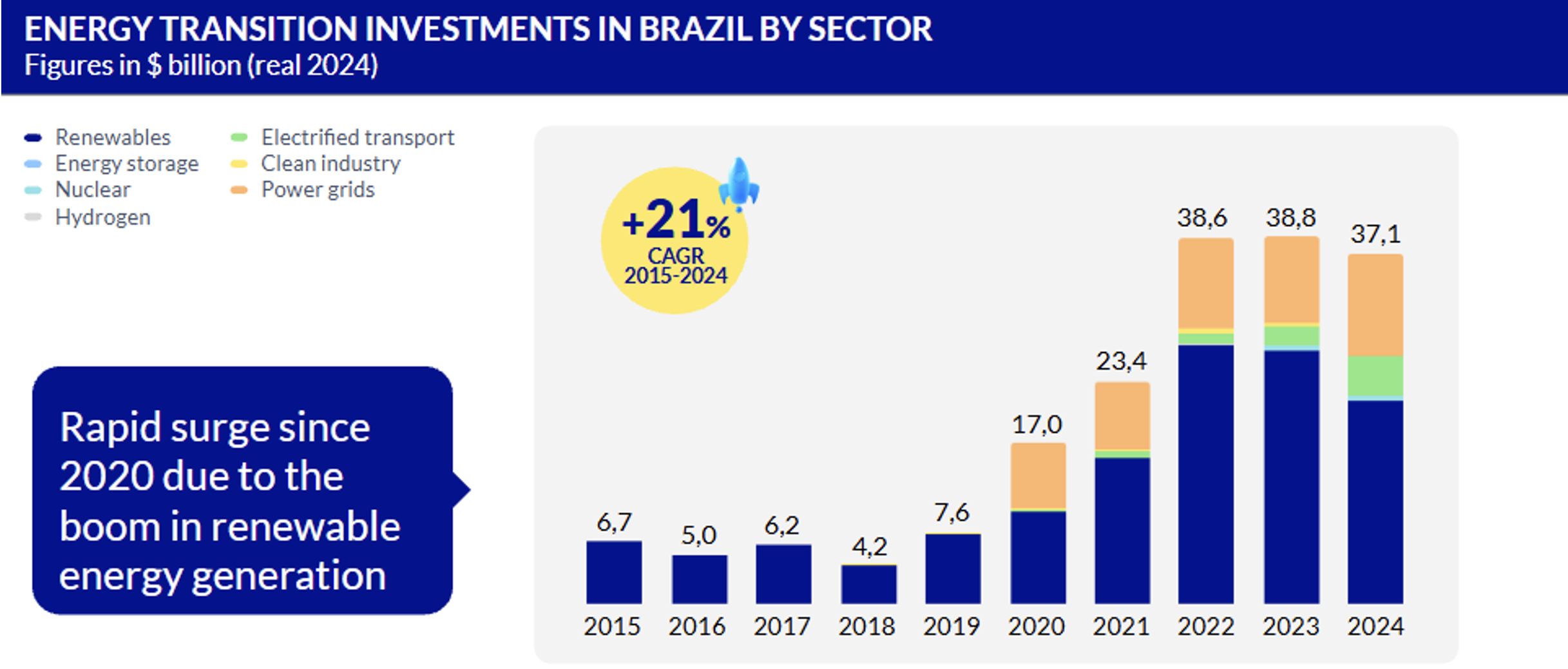
Power grids data was not collected before 2020
The role of banks in enabling the energy transition
In a market of this scale and complexity, banks play a critical role in turning sustainability ambition into execution. Brazil’s energy transition requires not only capital, but also structuring capabilities, risk management and long-term financing solutions tailored to sector-specific needs.
Banks act as:
- Capital mobilizers, channeling funding toward renewables, grids, electrified transport and sustainable infrastructure.
- Risk partners, helping clients navigate transition, regulatory and technology risks.
- Strategic advisors, supporting corporates as they reshape business models and investment plans in line with decarbonization pathways.
This role becomes increasingly relevant as investment shifts from pure generation toward grids, electrification, storage, data centers and clean industry, where projects are more complex and require tailored financing structures.
Key growth sectors over the next decade
This role becomes increasingly relevant as investment shifts from pure generation toward grids, electrification, storage, data centers and clean industry, where projects are more complex and require tailored financing structures. Brazil has clear sectoral priorities:
Electric vehicles:
Sales of electric vehicles for private consumers in Brazil are expected to quadruple by 2030, driven by improvements in total cost, low electricity prices, and strong policy support (with public programs such as MOVER). Brazil’s role as South America’s automotive hub (82% of regional production) and the expansion of Chinese OEMs are accelerating investment in vehicles, charging infrastructure, and fleet electrification. In public transport, Brazil is expected to have up to 13,000 electric buses by 2030, becoming the leader in Latin America in this market.
Power grids and transmission & distribution:
Rapid renewable deployment and electrification are shifting investment needs toward power grids, with electricity demand expected to grow +15% by 2030. Investments in transmission and distribution are projected to grow by around 10% over the next decade, supported by a regulated, long-term concession model that offers stable and bankable cash flows.
Data centers:
Brazil is already the largest data center market in Latin America, and installed capacity is expected to increase by x12 in the next five years. Competitive, increasingly clean power supply and strong demand from cloud and AI workloads position data centers as a key driver of investment in energy, grids and electrical infrastructure.
Biofuels, Sustainable Aviation Fuel (SAF) and Hydrogen:
Bioethanol demand is expected to grow x1.4 over the next decade, supported by higher blending mandates and the dominance of flex-fuel vehicles. At the same time, Brazil is emerging as a competitive producer of SAF and low-carbon hydrogen, leveraging feedstock availability, biofuel expertise and supportive regulation under the Fuel of the Future framework.
Water and sanitation
Despite having the world’s largest freshwater reserves, Brazil still lacks universal water and sanitation coverage. The new regulatory framework targeting 99% water access and 90% sewage coverage by 2033 is unlocking a large investment cycle, with private sector participation expected to double, reaching around 40% of the market.
Sustainable financing volume: already material, still growing
Sustainability is already material in Brazil’s financing activity, and the trend is visible both in volumes and market share. Sustainable financing volume grew at a compound annual growth rate of +6% over the past three years, reaching $45.4 billion in 2024 (compared to an average of $32.2 billion during the years 2021-2023), and accounting for nearly a quarter of the total market in 2024 (around ~21.6% of total market weight).
The future opportunity is scenario-dependent: Under a base-case scenario — combining technological competitiveness and supportive public policies — sustainable financing volume could reach $59 billion by 2030, but the value ultimately realized will depend on the pace of policy implementation, the economic viability of technologies, and project delivery capacity.
In addition, the “financeable” scope is constrained by concentration risks (with Energy representing ~40% of the total), supply chain dependencies — particularly imports from China for key components — and a short-term rebalancing of investments, as current overcapacity in renewables may slow new generation while growth shifts toward electrified transport and other segments.
Brazil: where sustainability turns into business
Brazil is moving from sustainability as a narrative to sustainability as a central driver of economic and financial growth. Scale, competitiveness, resource diversity, and political ambition are converging, creating a market where the energy transition is already translating into tangible investment opportunities.
For BBVA, this represents a strategic moment to strengthen our value proposition, supporting our clients in the transition while capturing value in one of the most relevant and high-growth sustainability markets globally.