





News | 03 February 2026
Latin America: navigating growth, resilience and opportunity in a more fragmented world
BBVA held the 12th edition of its Latin America Conference, bringing together policymakers, central bankers, investors, and business leaders to discuss the macroeconomic, political, and market outlook for the region in an increasingly uncertain global environment. The conference offered a comprehensive view of Latin America’s prospects, highlighting both the region’s resilience and the need for greater selectivity in the context of slowing global growth.
BBVA’s Strategic Vision for Institutional Clients
The conference opened with a strategic overview by Javier Rodríguez Soler, Global Head of Sustainability and Global Head of Corporate & Investment Banking at BBVA, who presented the bank’s growth plan for institutional clients. This strategy is built on three closely interconnected pillars: a radically client-centric approach, deep sector specialization, and strong global and cross-border capabilities. Rodríguez Soler emphasized BBVA’s long-term relationship-driven DNA and the role of sustainability as a structural driver of value creation and risk management.
A more fragmented global environment
Alejandro Werner, Director of the Georgetown Americas Institute and former IMF Director, set the global macroeconomic context, warning about growing fiscal imbalances, elevated public debt, and weaker international coordination. Structural uncertainty surrounding the US dollar, the uneven impact of artificial intelligence, and the erosion of the international economic order point to a more volatile environment looking ahead to 2026.
Central banks: credibility, gradualism and resilience
Central banks across the region shared key messages. In Mexico, Omar Mejía Castelazo, Deputy Governor of Banco de México, explained that inflation remains contained and monetary policy restrictive, allowing for a gradual approach in the face of transitory shocks.
From Brazil, Daniel Cardoso Leal highlighted how structural reforms have strengthened growth and fiscal discipline, supported by a predominantly local-currency debt profile and a diversified investor base. In Colombia, Leonardo Villar warned of fiscal and credibility risks stemming from the minimum wage increase, while advocating for a prudent and gradual monetary policy stance.
Peru and Chile presented more favorable outlooks. Julio Velarde underscored the strength of domestic demand, private investment and Peru’s solid external accounts. In Chile, Alberto Naudon noted that inflation is converging toward target and that monetary policy is close to neutral levels.

Politics, markets and investor perspectives
Brian Winter, Executive Vice President of the Americas Society/Council of the Americas, analyzed the political shift underway in the region, driven by security concerns and an evolution of traditional political agendas. Investor panels converged on a constructive yet selective stance toward emerging market local currency debt, with Latin America standing out for its high real interest rates and credible monetary frameworks.
Investors highlighted the continued appeal of EM local currency debt, noting that while 2026 may deliver lower returns than 2025, opportunities remain for active and selective investors. Latin America stands out within emerging markets due to its high real rates, credible monetary policy frameworks and event-driven opportunities. Brazil emerged as the consensus favorite across both rates and FX, while Mexico was viewed as the strongest long-term conviction, particularly in fixed income. Colombia offered attractive valuations, albeit with a political risk-driven profile.
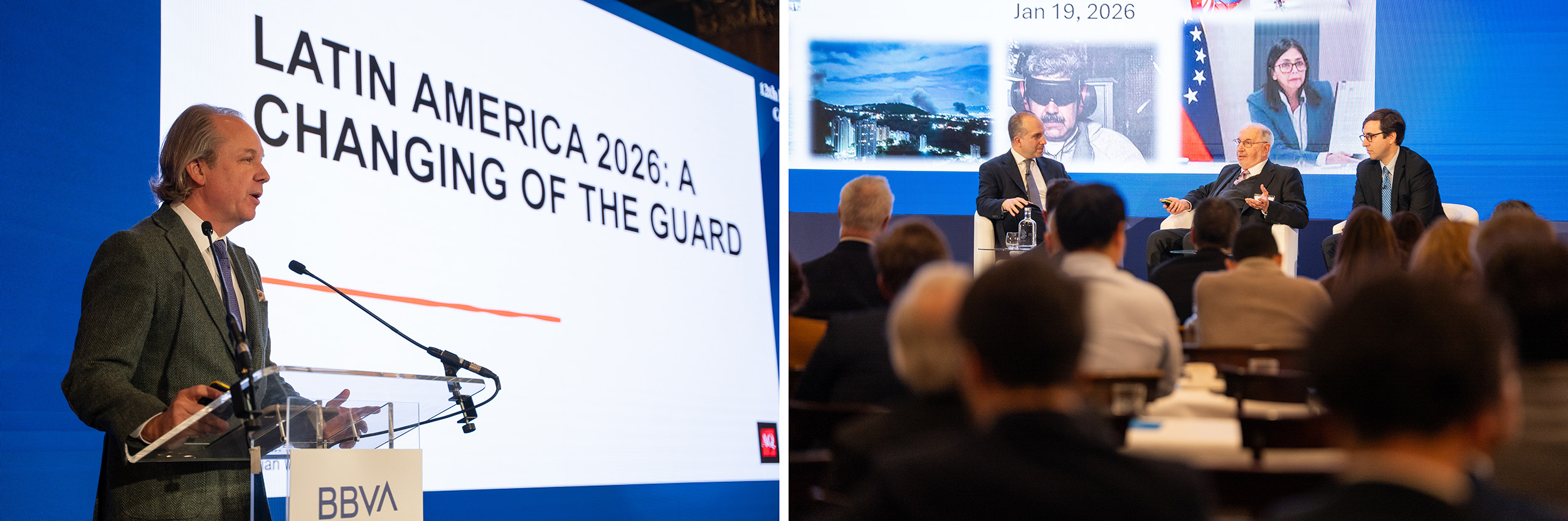
Argentine Deputy Governor Vladimir Werning detailed progress under the current macro framework, highlighting fiscal adjustment, disinflation, and a roadmap focused on remonetization and reserve accumulation.
The agenda concluded with Argentina and Venezuela, two key economies for the region. Argentine Central Bank Deputy Governor Vladimir Werning highlighted progress in macroeconomic stabilization and reforms.
A panel on Venezuela emphasized that while oil flows could provide short-term stabilization, a durable recovery will depend on the rule of law, institutional reform and a credible political transition.
The 12th BBVA Latin America Conference underscored the region’s complexity and differentiation, highlighting the importance of local insight, disciplined risk assessment and global execution. In this context, BBVA reaffirmed its role as a strategic partner for institutional investors, combining regional expertise with global capabilities to help clients navigate uncertainty and capture opportunities across Latin America.
