




News | 23 September 2026
Today’s Consumer: More Information, More Choice, Higher Expectations
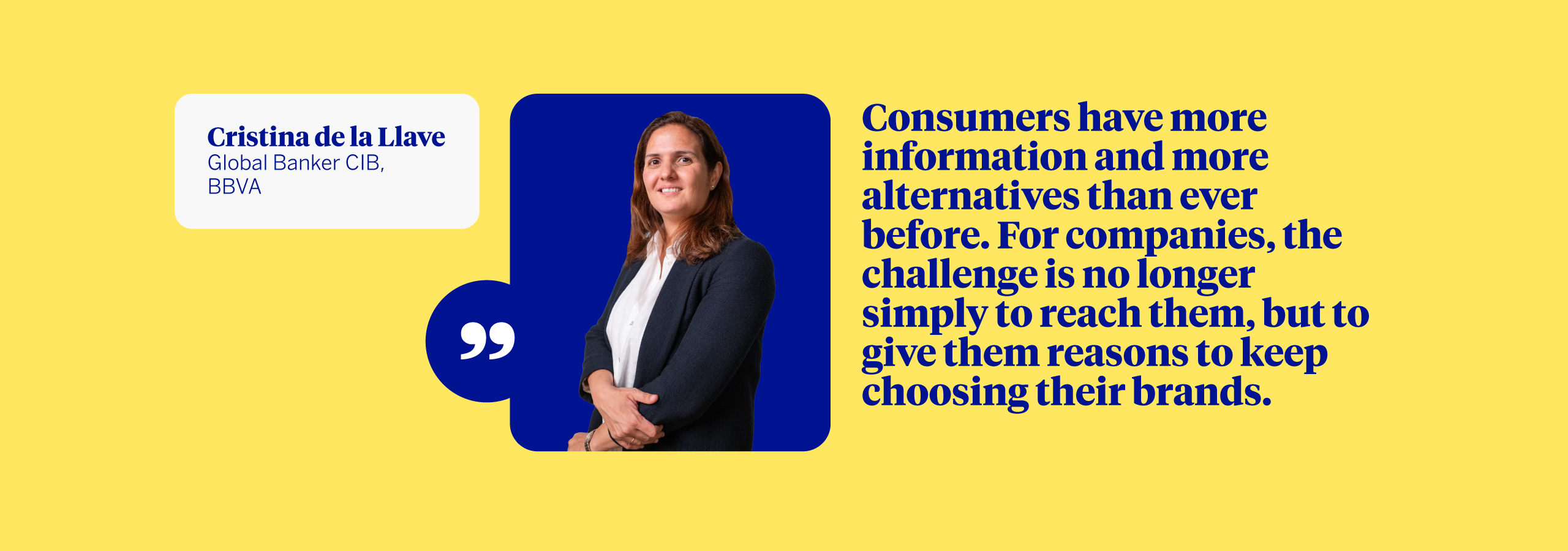
Cristina de la Llave, Global Banker CIB, BBVA
Never before have we had so much information or so many choices at our fingertips. We can discover a product on social media, compare prices and reviews in seconds, buy it in-store or on our phones and, increasingly, look for it on the second-hand market as well.
This greater freedom of choice is reshaping consumer behaviour and raising expectations. For companies, the challenge is no longer simply to reach consumers, but to understand what makes a brand, product or experience worth choosing from among all the alternatives available.
More choice, greater freedom to choose
The consumer sector has always been accustomed to change. Trends come and go, and companies evolve with them. But in recent years, we have been witnessing something more profound: it is not only what we buy that is changing, but how we decide what is worth our money and our time.
Consumers are comparing more and making different choices depending on the category and the occasion. They may opt for a basic alternative for an everyday product while, at the same time, being willing to spend more on an experience, a trip, a good meal or something they consider special.
In Spain, this shift is particularly evident in the greater relative priority consumers are placing on experiences over certain categories of material goods.
Price matters, especially after several years shaped by inflation and economic uncertainty, but it explains only part of this behaviour. What consumers are looking for is value, and value can mean different things: quality, convenience, experience, durability, brand or price.
McKinsey notes that this search for value cuts across categories and income levels, with more than three-quarters of consumers switching from their first choice to a lower-priced alternative in at least one category.
We are therefore not simply seeing consumers who want to spend less. We are seeing consumers becoming much more selective about where they choose to spend.
The purchase decision starts long before the purchase itself
The way we discover and choose products has also changed profoundly.
A company’s store or website is now just one of many touchpoints influencing a purchase decision. Social media, content creators, reviews from other consumers, digital platforms and search algorithms are playing an increasingly important role in that process.
Among Generation Z, 23% say they have discovered new brands through social media, compared with just 7% of baby boomers, according to McKinsey’s 2026 global consumer survey.
This represents an important shift for brands. Being present remains essential, but it no longer guarantees relevance. Perceptions of a company are shaped across many more spaces and through voices that companies do not always control.
For businesses, understanding where and how consumer preference is formed today is therefore becoming an increasingly strategic priority.
Consumers no longer distinguish between channels
That same freedom extends to the moment of purchase.
A consumer may discover a pair of sneakers on social media, try them on in a store and ultimately buy them online because their size is available there. Or they may spend days researching a product online before going to a store to see it in person and complete the purchase there.
The boundaries between the physical and digital worlds have blurred and, with them, the old debate between stores and e-commerce has become increasingly irrelevant. Consumers do not necessarily think in terms of channels: they expect to be able to move seamlessly between them.
For retailers, the challenge is to make that transition genuinely frictionless. Consistent pricing and promotions, inventory visibility, the ability to receive or return a product regardless of where it was purchased, and employees equipped with real-time information are now all part of the experience consumers expect.
And as comparing options and switching between alternatives becomes easier, tolerance for friction diminishes. The customer experience is therefore no longer an added extra; it has become an integral part of the value proposition.
Second-hand enters the purchase decision
The expansion of the second-hand market is perhaps one of the most interesting examples of how consumer choice is broadening.
Buying second-hand is no longer solely a matter of budget. It can provide access to higher-end brands or better-quality products, offer the opportunity to find distinctive items, extend products’ useful lives and allow consumers to recover some of their value when they are no longer needed.
The global second-hand apparel market could reach $393 billion by 2030, growing at an annual rate of close to 9%, according to ThredUp and GlobalData’s Resale Report 2026.
But its influence extends beyond the transaction itself. Second-hand platforms are also becoming part of how consumers discover, compare and assess products. A Vinted study found that 88% of its buyers check the platform before purchasing something new.
This introduces a particularly relevant dimension for companies: a product’s value no longer necessarily ends with its first sale. Its durability, its potential for a second life and even its resale value can all shape consumers’ perceptions of the product.
This evolution also opens up new opportunities to advance towards more clearly defined circular consumption models with concrete objectives.
Adapting to remain relevant
More information, more channels and more alternatives are giving consumers unprecedented freedom of choice. And that is changing the rules for companies.
Brand, scale and distribution remain fundamental, but competing in this new environment requires more: a deeper understanding of consumers, consistent experiences, innovation in products and business models, and the ability to anticipate where value is shifting.
It also means responding to expectations that extend beyond the purchase itself. Product durability, circularity, resource use and the transformation of value chains are increasingly becoming part of the strategic decisions facing consumer companies.
For many businesses, addressing these changes requires investment and a long-term perspective.
At BBVA, we support our clients through this transformation by combining sector expertise, financial capabilities and our experience in sustainability. We work with them to understand how their markets are evolving, identify opportunities and mobilise the financing needed to make progress in areas such as efficiency, decarbonisation, circularity and the transformation of their value chains.
Because in a market with more information and more alternatives than ever, the advantage lies not only in reaching consumers. It lies in understanding what they value and evolving alongside them so that they continue to choose you.