





News | 11 November 2026
Foreign Exchange Risk Management and Hedging
Foreign exchange management enables companies to identify, measure and manage their exposure to exchange rate fluctuations. Through hedging policies and financial instruments such as forwards, options and FX swaps, a company can reduce the impact of currency risk on its cash inflows, outflows, margins and financial planning.
Companies that export, import, have international subsidiaries or transact in different currencies may be exposed to currency risk. An unexpected movement in a relevant currency can change the value of a future receipt or payment and affect the expected profitability of a transaction.
The aim of currency risk management is not to predict market movements or generate speculative gains. It is to understand the company’s exposure and establish mechanisms to reduce the impact of adverse exchange rate movements and bring greater predictability to financial planning.
To do this, companies can analyse their revenue, costs, assets and liabilities in each currency, as well as the time lags between negotiating prices, invoicing and making or receiving payments. Based on this analysis, treasury teams can establish policies and hedges tailored to their exposure.
What is currency risk and how does it affect a company?
Currency risk, also known as foreign exchange risk, is the possibility that changes in the value of one currency relative to another will have a financial impact on a company.
For a company operating internationally, this risk can take several forms:
- Transaction exposure: arises when future receipts or payments are denominated in a currency other than the company’s functional currency. A change in the exchange rate before settlement can alter the final value of the transaction.
- Translation risk: primarily affects groups with subsidiaries, assets or liabilities in different countries. When consolidating financial statements, currency fluctuations can change the value of certain items in the presentation currency.
- Economic exposure: reflects the impact that sustained exchange rate movements can have on a company’s competitiveness. For example, a significant change in a competitor’s currency can alter its relative costs and its ability to compete in certain markets.
How can currency risk be hedged?
Companies can use various currency hedging instruments to reduce their exposure to adverse exchange rate movements.
The choice will depend on factors such as the currency, the size and tenor of the exposure , the certainty of future cash flows, the company’s financial objectives and its risk management policy.
- Forward contracts
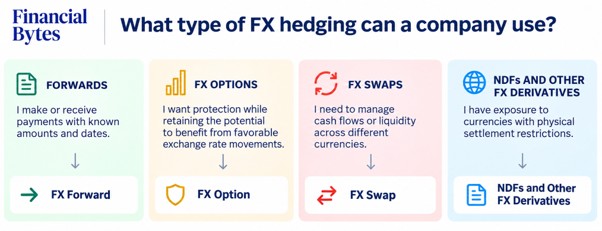
A currency forward, also known as a forward exchange contract, allows a company to agree an exchange rate for a transaction that will take place on a future date.
This means the company knows in advance the rate applicable to the hedged amount and gains greater predictability over the corresponding receipt or payment. In return, it does not benefit from any favourable exchange rate movement on the hedged position.
A forward generally does not require an upfront premium, although other costs, conditions or requirements may apply to the transaction.
- Currency options
A currency option gives the holder the right , but not the obligation, to buy or sell a currency at a predetermined exchange rate.
In return for paying a premium, it allows a company to limit the effect of certain unfavourable movements while retaining the possibility of benefiting from favourable market movements, subject to the terms of the option purchased.
- FX swaps
FX swaps combine two foreign exchange transactions in opposite directions with different settlement dates.
They can be used, among other purposes, to manage temporary liquidity needs in different currencies or adjust the maturity of certain foreign currency positions.
- Other currency derivatives
Depending on the exposure and the characteristics of the transaction, other instruments may also be used, such as NDFs (non-deliverable forwards), futures and option structures, alongside other currency derivative solutions.
Which FX hedging instrument should a company use?
No single instrument is suitable for every exposure.
A company that needs to know in advance the exchange rate applicable to a future payment or receipt may consider a forward. If it wants to limit an adverse movement while retaining the possibility of benefiting from favourable movements, it may consider a currency option. FX swaps, meanwhile, can be used to manage liquidity needs or maturities in different currencies.
The choice of instrument should reflect the specific exposure, hedging objectives and each company’s financial and risk policies.
Good practice in managing currency risk
A currency risk management policy starts with understanding the company’s exposures and establishing clear criteria for which risks to manage, in what proportion, over what time horizon and using which instruments.
One alternative that can be considered is natural hedging. This involves offsetting receipts and payments denominated in the same currency wherever possible. In this way, the company reduces its net exposure and the need for additional currency conversion or hedging transactions.
Managing balances in different currencies can also facilitate the management of international cash flows where the operational structure and available banking products allow.
Another important element is establishing a budget exchange rate that is consistent with the company’s financial policy. This internal reference supports the preparation of budgets and forecasts for sales, costs and earnings, taking account of currency exposure and the costs associated with hedging.
It is also important to establish appropriate governance, with limits, authorisation processes and controls over foreign exchange transactions and, where the organisational structure allows, adequate segregation of exposure identification, execution, confirmation and reconciliation.
What benefits can currency risk hedging offer?
A currency hedging policy can reduce the uncertainty associated with certain foreign currency cash flows and support financial planning.
Potential benefits include greater predictability of cash flows, reduced exposure of expected margins to adverse currency movements and improved treasury planning .
It can also help to reduce certain sources of financial volatility when hedges are appropriately designed and accounted for.
Currency hedging, however, does not eliminate all the risks of an international transaction or guarantee its outcome. Its effectiveness depends on correctly identifying the exposure, the proportion hedged, the timeframes, the instrument used and the actual timing and amount of the company’s cash flows.
Foreign exchange management with BBVA CIB
BBVA CIB supports companies and institutions in managing their exposure to currency risk, combining global reach, knowledge of local markets and execution and risk management capabilities.
Its Foreign Exchange (FX) offering includes solutions such as spot transactions, forwards, FX swaps, options and other currency derivatives, alongside digital capabilities and access to specialist analysis to address different hedging and execution needs in international markets.
By analysing each company’s exposure and financial objectives, BBVA CIB can offer alternatives tailored to different currencies, time horizons and risk profiles.
Frequently asked questions about foreign exchange management:
What is foreign exchange management?
Foreign exchange management involves identifying and managing a company’s exposure to exchange rate movements. Its purpose is to reduce the uncertainty these fluctuations can create for receipts, payments, margins, cash flows and other financial measures.
What is a currency hedge?
A currency hedge is a transaction intended to reduce exposure to adverse exchange rate movements. It can be implemented using different financial instruments, such as forwards, options or FX swaps, depending on the characteristics of the exposure.
What is the difference between a forward and a currency option?
A forward allows a company to agree an exchange rate for a future transaction and provides certainty over the rate applicable to the hedged amount. An option gives the right, but not the obligation, to buy or sell a currency at a predetermined rate and generally requires payment of a premium.
Which companies are exposed to currency risk?
Companies may be exposed if they receive or make payments in currencies other than their functional currency, import or export goods and services, hold investments or financing in other currencies, or have subsidiaries and international operations.
Does a hedge completely eliminate currency risk?
Not necessarily. A hedge can reduce the impact of certain exchange rate movements on an identified exposure, but its outcome depends on the instrument used, the proportion and period hedged, and how the company’s cash flows actually develop.