




News | 28 October 2026
Working capital management: how do companies optimise liquidity?
Efficient working capital management is essential to ensure the continuity of companies’ day-to-day operations. In an environment where liquidity occupies a central place in financial strategy, optimising the resources allocated to operating activities can reduce financing requirements, anticipate potential cash flow pressures and support companies’ sustainable growth.
Working capital management involves administering the financial resources a company needs to conduct its daily business. Its aim is to ensure that the company has sufficient liquidity to meet its short-term obligations while avoiding unnecessarily tying up resources. To achieve this, companies must strike a balance between inventories, trade receivables, trade payables and available cash.
From a financial perspective, net working capital is calculated as the difference between current assets and current liabilities. Operating working capital management, meanwhile, focuses mainly on inventories, trade receivables and trade payables, which determine a significant proportion of the financing required for business operations.
Efficient management of these resources helps maintain day-to-day operations, improve cash availability and reduce reliance on external financing. It also helps companies anticipate potential mismatches between receipts and payments and gives them greater flexibility to undertake new investments or meet unforeseen needs.
Why is working capital important for companies?
Working capital management has a direct impact on companies’ financial stability and operational capacity. Even companies with strong revenue and profitability figures may experience difficulties if they do not have sufficient liquidity to meet their obligations when they fall due.
This risk may increase during periods of expansion. Sales growth often requires greater investment in inventories, raw materials and other operating resources. At the same time, an increase in credit sales may raise trade receivables, creating additional financing needs before revenue is converted into cash.
Companies must therefore balance business growth, operating profitability and the availability of liquidity. They need resources to cover recurring expenses, purchase raw materials, meet commercial commitments and respond to unforeseen events.
Efficient working capital management can reduce the resources tied up in operations, limit financing requirements and improve the efficiency with which assets are used. Depending on the associated costs and commercial terms, it may also help improve profitability and strengthen the company’s financial flexibility.
Key working capital metrics
To assess how efficiently a company manages its working capital, finance teams use a range of indicators to analyse inventory holding, collection and payment periods. These metrics help identify potential inefficiencies and show how long financial resources remain committed within the operating cycle.
The main indicators include:
- DIO (days inventory outstanding): measures the average number of days that inventory remains in storage before it is sold. A high figure may indicate that more resources are tied up, although its interpretation depends on the sector and business model.
- DSO (days sales outstanding): indicates the average number of days a company takes to collect payment for credit sales. It helps assess the efficiency of collection management and the commercial terms offered to customers.
- DPO (days payables outstanding): reflects the average time a company takes to pay its suppliers. It helps analyse how payment commitments are managed and their impact on liquidity.
These three indicators are used to calculate the cash conversion cycle (CCC), which measures the average length of time for which financial resources remain committed within a company’s operating cycle.
The formula is:
CCC = DIO + DSO − DPO
For example, if a company holds inventory for 60 days, takes 45 days to collect payment from customers and pays suppliers within an average of 50 days, its cash conversion cycle will be 55 days.
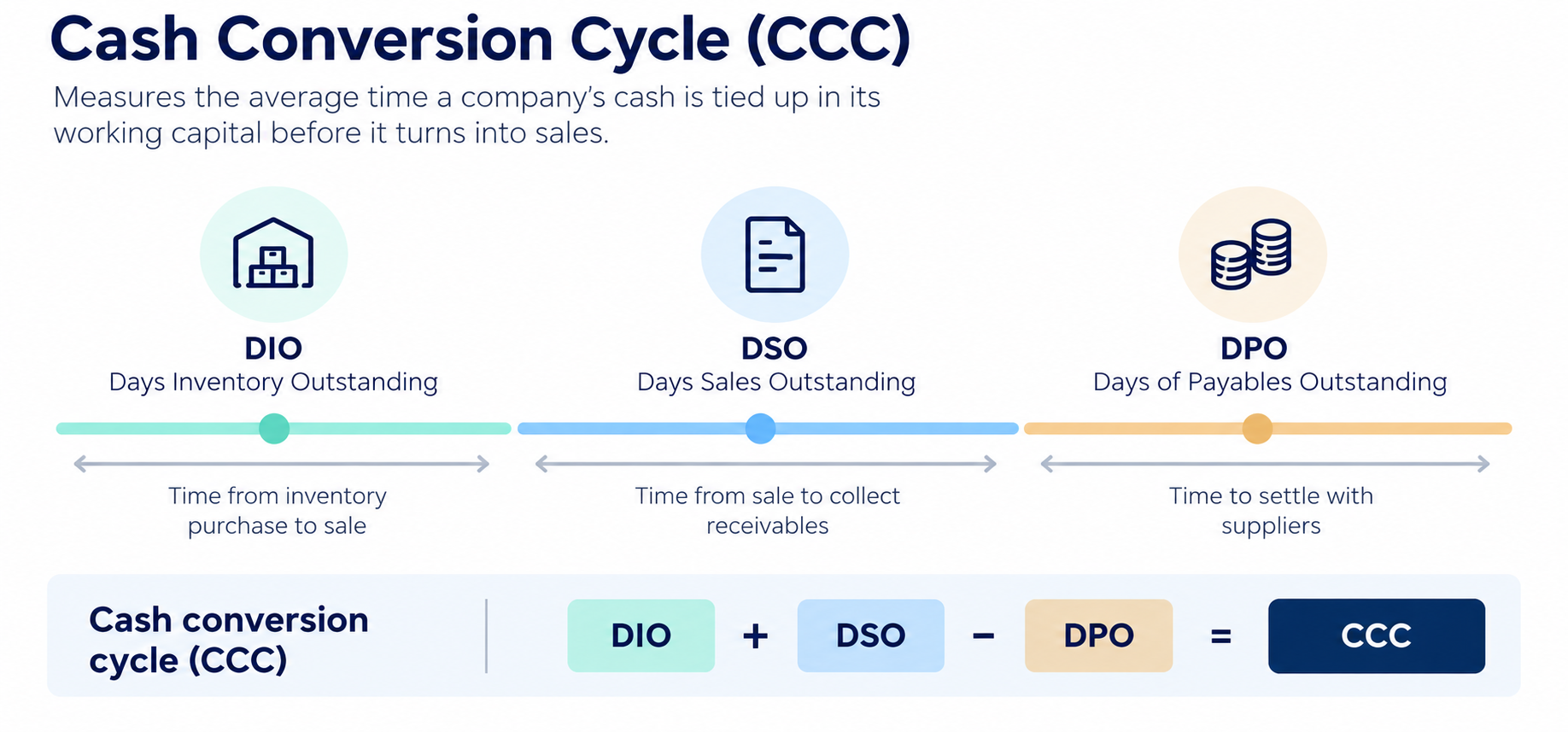
In general terms, a shorter cycle means that the company needs to finance its operating activities for less time, which supports liquidity. However, the characteristics of the business must be taken into account, as reducing inventory excessively or changing payment terms may affect continuity of supply and commercial relationships.
Strategies to improve working capital
Optimising working capital requires coordinated action across collections, inventory management, purchasing and payments. Companies can implement various measures to improve access to liquidity and reduce the resources committed to their day-to-day activities:
- Accelerate collections: establish appropriate credit terms, automate payment reminders and offer early-payment discounts when their cost is advantageous for the company.
- Optimise inventories: align inventory levels with forecast demand and improve purchasing and supply planning to reduce tied-up capital without compromising production or customer service.
- Manage supplier payments: negotiate payment terms and periods that support better liquidity management while honouring commercial commitments and preserving supply-chain stability.
- Forecast cash requirements: update cash flow forecasts regularly to anticipate potential mismatches between receipts and payments and take action sufficiently early.
- Automate administrative processes: use digital tools to streamline invoicing, improve transaction reconciliation, reduce errors and avoid delays in managing collections and payments.
- Use short-term financing when necessary: use instruments such as credit facilities to cover temporary liquidity needs while seeking to avoid structural dependence on these sources of financing.
Combining these measures can improve the efficiency of the operating cycle and adapt working capital management to each company’s needs.
Working capital finance solutions
Large corporations have access to a range of financial instruments to manage their working capital requirements and improve liquidity availability. BBVA CIB offers specialist financing solutions that address different components of the cash cycle while taking account of each company’s operational and financial characteristics.
- Receivables finance: enables companies to bring forward the collection of credit sales and obtain liquidity before invoices fall due. One of the main solutions is factoring, through which a company can assign its receivables to a financial institution and gain early access to funds. Depending on the terms of the transaction, it may also transfer certain default risks. For companies with a high volume of receivables, financing structures based on portfolios of receivables and asset securitisation transactions are also available; these can facilitate access to finance and diversify funding sources. The accounting treatment and transfer of risks depend on the characteristics of each transaction.
- Supply chain finance: supports improved management of supplier payments and facilitates access to liquidity for companies within the supply chain. One of the main solutions is reverse factoring, also known as confirming, which enables suppliers to receive early payment of their invoices through a financial institution. Suppliers can therefore receive funds before the due date while the purchasing company retains the agreed payment terms. These solutions can help improve suppliers’ financial stability and facilitate more efficient cash flow management.
- Inventory finance: enables companies to obtain financing linked to their inventories, such as raw materials, work in progress or finished goods, and to reduce the pressure that holding them places on liquidity. These solutions are particularly useful for companies with long production cycles, seasonal procurement requirements or high inventory volumes. Through structures tailored to the characteristics of the assets and operations, companies can access financial resources while retaining the inventory required to ensure business continuity.
In addition to financing instruments, cash management solutions can improve the management of collections, payments and treasury positions. Automating and centralising these processes provides greater visibility over cash flows and helps companies make financial decisions using more accurate, up-to-date information.
The role of banks in optimising working capital
Liquidity management is a priority for companies seeking to maintain financial stability and secure the resources needed to conduct their business. Financial institutions play an important role in this area by offering solutions that enable companies to bring forward collections, manage payments and meet financing needs linked to the operating cycle.
Analysing indicators such as DSO, DIO, DPO and the cash conversion cycle helps identify opportunities for improvement and assess which financial instruments may be best suited to each company.
BBVA CIB specialists support corporate clients in analysing their working capital requirements and structuring financing solutions tailored to their circumstances. These tools can help release resources tied up in operations, improve liquidity availability and optimise financing requirements, contributing to more efficient financial management and a greater capacity to address business challenges.
If you need to optimise your working capital, bring forward collections or improve payment management, BBVA CIB can help. Our specialists analyse your business needs to provide financing solutions tailored to your operations, enabling you to release resources, improve liquidity and gain greater financial flexibility to meet your next challenges.